


John Doolittle has spent a career at the intersection of combat and human performance. A retired U.S. Navy SEAL, he served in leadership roles across the special operations community, including helping shape programs designed to sustain the physical, cognitive and psychological demands placed on elite forces.
Since retiring, he has continued that work in the private sector, advising on human performance optimization and supporting Department of Defense efforts through industry partnerships. His perspective is shaped not just by years in combat, but by direct involvement in one of the military’s most consequential efforts to better care for its people.
In a recent interview, Military.com sat down with Doolittle to discuss what the broader force can learn from those efforts.
The U.S. military has long mastered the art of maintaining its most complex weapon systems. From fighter jets to ground vehicles, there are clear maintenance cycles, predictive analytics and service-life extension programs designed to ensure performance under pressure.
But when it comes to the most critical system of all, the individual service member, the approach has often lagged behind.
A recent conversation with Doolittle, who led U.S. Special Operations’ enterprise-wide human performance program (POTFF) for three years, highlights a growing shift in how the military is beginning to think about readiness: not as something managed after the fact, but as something that can be predicted, prepared for and sustained over time.

The Limits of a Reactive Model
For decades, the military has relied heavily on a reactive model of care addressing injuries, mental health challenges and family stressors only after they surface.
That model works. But it also leaves gaps.
Doolittle recalls watching a young remotely piloted aircraft pilot execute a strike and then immediately transition back to everyday life, leaving the operations floor to pick up her children from daycare.
“There’s no decompression,” he said. “No transition. Just straight from combat to home life.”
In traditional deployments, service members often had some buffer, time to process, reset and reconnect. But in modern warfare, especially in remote or distributed environments, that buffer is disappearing.
The result is cumulative stress that builds quietly often until it becomes a problem.
Enter POTFF: A Different Model of Readiness
Special Operations didn’t stumble into a better system by accident. It was forced to adapt.
After years of sustained combat following 9/11, troubling trends emerged: rising suicide rates, family strain, substance abuse and burnout across the force.
In response, SOCOM formally established the Preservation of the Force and Family (POTFF) program in 2013 to address those pressures head-on.
At its core, POTFF represents a shift in mindset.
Its mission is to optimize and sustain readiness, performance and longevity through integrated human performance programs that strengthen both the force and the family.
The philosophy behind it is simple, and echoed by Doolittle:
Humans are more important than hardware.

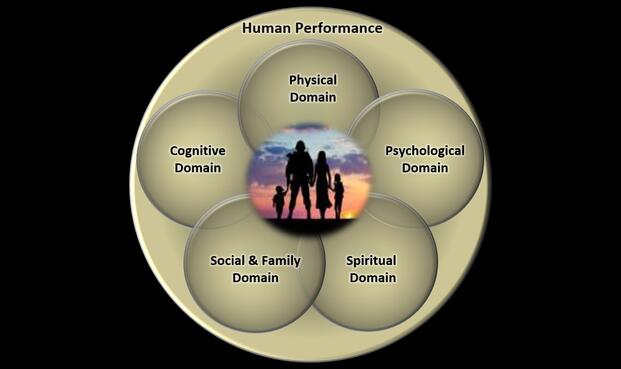
The Five Domains of Human Performance
POTFF reframes readiness as a system and not a single variable.
Instead of focusing narrowly on physical fitness or post-incident care, it organizes support across five interconnected domains:
- Physical (strength, recovery, injury prevention)
- Psychological (behavioral health, resilience, suicide prevention)
- Cognitive (decision-making, brain health, performance under stress)
- Social & Family (relationships, support systems, reintegration)
- Spiritual (purpose, values, meaning)
These domains aren’t independent. They function as an integrated system, or what SOCOM often refers to as the “human weapon system.”
“You can’t optimize one and ignore the others,” Doolittle said. “They all interact.”
Embedding Care Where It Matters
One of the most impactful elements of POTFF, and one Doolittle emphasized repeatedly, is how care is delivered.
Instead of pushing service members toward clinics, POTFF embeds professionals directly into operational units.
Behavioral health providers, physical therapists, strength coaches and other specialists are part of the daily environment.
“They’re in the gym. They’re in the hallways. They’re part of the team,” Doolittle said.
That proximity matters.
It builds trust. It reduces stigma. And it changes behavior.
When junior personnel see respected senior leaders using those resources openly, help-seeking becomes normalized and not avoided.
POTFF was designed specifically to do this: increase access to care while minimizing the stigma traditionally associated with seeking help.
From Reactive to Predictive
The deeper shift, however, isn’t just about access. It’s about timing.
POTFF is intentionally proactive, designed to prevent issues before they emerge, not just respond after they do.
That aligns directly with how the military treats equipment.
“We know exactly what it takes to maintain a $90 million aircraft,” Doolittle said. “We track it, we predict failures, we fix things before they break.”
His argument is straightforward:
The military should apply the same logic to people.
That means establishing what he describes as a “service life extension program” for the human weapon system by using data, early intervention and integrated care to extend performance and longevity over time.
The ROI of Taking Care of People
The impact of this approach is difficult to isolate in purely statistical terms. Human systems rarely produce clean cause-and-effect outcomes.
But the trends are clear.
POTFF has been associated with improvements in resilience, stabilization of negative behavioral trends and increased operational longevity.
Doolittle points to one striking example: operators in their late 40s, even 50, still actively contributing to missions on target.
“Twenty years ago, tactical guys aged out in their mid-30s,” he said.
That matters.
SOCOM invests heavily in training elite operators. Extending their careers improves continuity, preserves experience and enhances mission effectiveness.
From a return-on-investment perspective, the logic is hard to ignore.
Data as the Backbone
POTFF also reflects a growing emphasis on data.
The program incorporates assessment, monitoring and analytics across its domains, from physical performance metrics to cognitive baselines.
Doolittle sees this as the future.
Systems like MHS GENESIS create the potential to integrate medical, behavioral and performance data into a unified picture.
“If we have the data,” he said, “we should be able to predict where problems are going to occur.”
That capability, if fully realized, could fundamentally change how the military manages readiness.
The Cost Conversation
POTFF is not cheap.
At its peak, the program has supported hundreds of embedded professionals across dozens of locations worldwide.
But Doolittle argues the cost question is often framed incorrectly.
“Yes, it’s expensive,” he said. “But so is losing people. So is dealing with problems after the fact.”
Much of the burden today falls on downstream systems, including the Department of Veterans Affairs, once issues have already compounded.
Shifting resources earlier in the lifecycle could reduce both human and financial costs over time.
A Model Worth Scaling
Today, POTFF remains largely concentrated within Special Operations, a relatively small portion of the total force.
That’s the tension.
SOCOM represents only a fraction of the Department of Defense. But it has effectively piloted a model that addresses many of the challenges the broader military continues to face.
“There’s nothing about this that’s unique to Special Operations,” Doolittle said. “The demands may be different, but the human system is the same.”
Programs like the Army’s Holistic Health and Fitness initiative suggest the military is moving in that direction.
But the scale, and the consistency, are not yet there.

The Bottom Line
The military has always adapted to new forms of warfare.
Today, the challenge is not just technological, it’s human.
As the nature of conflict evolves, so do the demands placed on service members physically, cognitively, emotionally and socially.
POTFF represents one of the clearest examples of what a modern readiness model can look like: integrated, proactive and built around the reality that people, not platforms, are the decisive advantage.
The military already knows how to extend the life of its aircraft.
The next step is doing the same for its people.





