


In the winter of 1918, an illness was spreading in Haskell County, Kansas.
The remote farming community in the state's southwestern corner sat roughly 300 miles from anywhere most Americans would recognize. Its residents raised hogs, tended cattle and scraped by on the prairie. But starting in January, a local physician named Dr. Loring Miner began seeing patients struck with an influenza unlike anything in his decades of practice.
This was not a typical seasonal illness. Strong, healthy adults were being knocked flat by violent headaches, high fevers and relentless coughs. Some of them died. Miner grew alarmed enough to file a formal warning to the U.S. Public Health Service, reporting an "influenza of a severe type."
His alert was published in Public Health Reports, a weekly journal meant to flag outbreaks of communicable diseases. In the first six months of 1918, it would be the only mention of influenza anywhere in the world in that publication.
Nobody investigated the outbreak, but soldiers at the nearby Fort Riley would soon be hit by the new illness.
The First Cases at Camp Funston
What Miner could not have known was that young men drafted from Haskell County were already traveling back and forth to Camp Funston, a sprawling Army training installation on the grounds of Fort Riley in eastern Kansas.
The camp was one of 16 built across the country after the United States entered World War I in April 1917. At its peak, Camp Funston processed nearly 56,000 troops preparing for deployment to France.
Fort Riley sat on 20,000 acres of Kansas prairie. Thousands of horses and mules were stabled on the post, producing roughly nine tons of manure that soldiers burned each month. The smoke mixed with the region's blinding dust storms to create a haze that hung over the installation.
Bone-cold winters gave way to stifling summers. Recruits lived in long rectangular barracks packed tight with bunks.
On the morning of March 4, 1918, an Army cook named Albert Gitchell reported to the camp infirmary with a sore throat, fever and headache. By noon, more than 100 soldiers had shown up with identical symptoms. Within a week, over 500 were hospitalized. After five weeks, 1,127 men at Fort Riley had fallen ill. Forty-six died.
The base surgeon diagnosed it as influenza. Military officials noted the outbreak but took no extraordinary action. The nation had bigger concerns. The war in Europe demanded every available body, and the Army was shipping tens of thousands of soldiers across the Atlantic each month.

The American War Machine Spreads the Disease
By April 1918, 24 of the 36 largest Army camps in the country were reporting influenza outbreaks. The virus spread with the constant stream of men transferring between installations for training, processing and deployment. In March alone, 84,000 American troops sailed for France. Another 118,000 followed in April.
The 89th and 92nd Infantry Divisions completed their training at Fort Riley and shipped out to French ports at Brest and Saint-Nazaire. Soon after they arrived, French soldiers in contact with the Americans began falling sick. British troops caught it next and carried the disease across the English Channel.
The Royal Navy reported more than 10,000 sailors stricken, effectively keeping parts of the fleet in port. The virus even spread into Germany, where 160,000 residents of Berlin soon contracted the illness.
The troopships themselves became floating incubators. Soldiers packed below decks in cramped quarters had no way to isolate the sick. The 15th U.S. Cavalry suffered 36 influenza cases and six deaths on a single Atlantic crossing. By war's end, an estimated 12,000 American troops would die of influenza aboard transport vessels before ever reaching France.
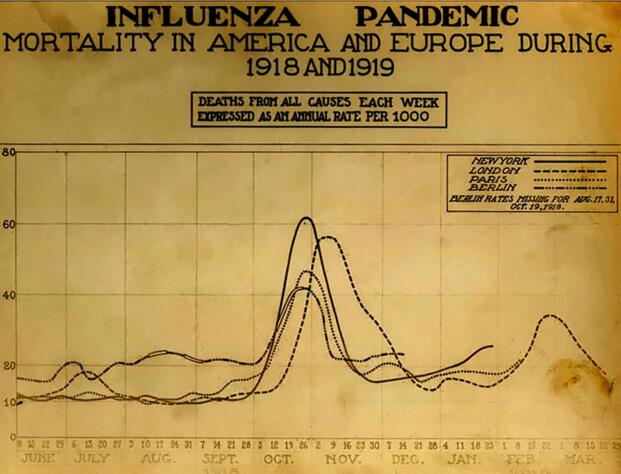
By midsummer, the pandemic had reached Russia, North Africa, India, China, Japan, the Philippines and New Zealand. The first wave, while widespread, remained relatively mild. Most patients recovered within days. The death toll was notable but not catastrophic.
However, it had reached all corners of the world and would come back on an even worse scale.
The Second Wave
In the fall of 1918, the influenza returned in a far more lethal form. Medical historians believe the virus mutated in the miserable conditions of trench warfare on the Western Front. The second wave appeared nearly simultaneously in August at the ports of Boston, Brest and Freetown, Sierra Leone.
At Camp Devens in Massachusetts, one of the largest Army training facilities in the country, the virus arrived in September and tore through the post. Dr. Victor Vaughan, dean of the University of Michigan Medical School and a colonel in the Army Medical Corps, was dispatched by the surgeon general to investigate. What he found at Devens haunted him for the rest of his life.
"I see hundreds of young, stalwart men in the uniform of their country coming into the wards of the hospital in groups of ten or more," Vaughan wrote in his memoir. "The faces soon wear a bluish cast; a distressing cough brings up the blood-stained sputum. In the morning the dead bodies are stacked about the morgue like cord wood."
More than 15,000 soldiers at Camp Devens contracted the virus. Over 800 died.
At Camp Upton in New York, the virus claimed victims with equal cruelty. Naomi Barnett traveled from Brockton, Massachusetts, to care for her fiance, Pvt. Jacob Julian, after he fell ill. She planned to marry him before he shipped overseas. She died two days after arriving at the camp. Julian died 30 minutes after her.
The Army's medical department recognized the threat and urged officials to halt troop transports, suspend the draft and quarantine soldiers. They were overruled. Gen. Peyton March convinced President Woodrow Wilson to keep the ships sailing. Wilson himself later contracted the flu at the Paris Peace Conference in 1919.
The Flu Hits the Combat Troops
The timing could not have been worse for the American Expeditionary Forces. On Sept. 26, 1918, the U.S. Army launched the Meuse-Argonne Offensive, the largest military operation in American history to that point. Some 1.2 million troops were committed to the 47-day campaign that would help end the war. The second wave of influenza peaked right in the middle of it.
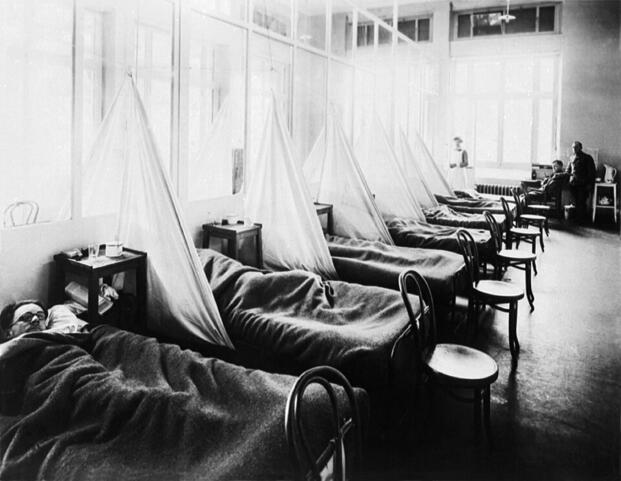
Hospitals along the front overflowed. Transportation lines choked with sick soldiers. AEF statistics showed that 340,000 troops were hospitalized for influenza during 1918. For comparison, 227,000 were admitted for combat wounds. The flu was generating more casualties than the fighting.
The Army Provost Marshal eventually had to cancel the October 1918 draft call because so many new recruits were falling ill upon arrival at training camps.
The pandemic did not spare the enemy. German Gen. Erich Ludendorff, who had directed Germany's last major offensive that spring, later wrote that the flu gutted his fighting force at a critical moment.
"It was a grievous business having to listen every morning to the chiefs of staffs' recital of the number of influenza cases, and their complaints about the weakness of their troops," Ludendorff recalled in his memoirs.
Crown Prince Rupprecht of Bavaria noted in his diary on Aug. 3, 1918, that "poor provisions, heavy losses and the deepening influenza have deeply depressed the spirits of the men in the III Infantry Division."
Nursing Sister Catherine Macfie, stationed at a casualty clearing station in France, witnessed the toll firsthand.
"The boys were coming in with colds and a headache and they were dead within two or three days," she recalled. "Great big handsome fellows, healthy men, just came in and died."
Elizabeth Harding, a nurse at Fort Riley, described the scene back at the outbreak's origin point in a letter.
"I left Fort Riley in October of 1918, for duty in the Office of the Surgeon General," she wrote. "The flu epidemic had just struck, and the day I left there were over 5,000 patients."
Why 'Spanish' Flu?
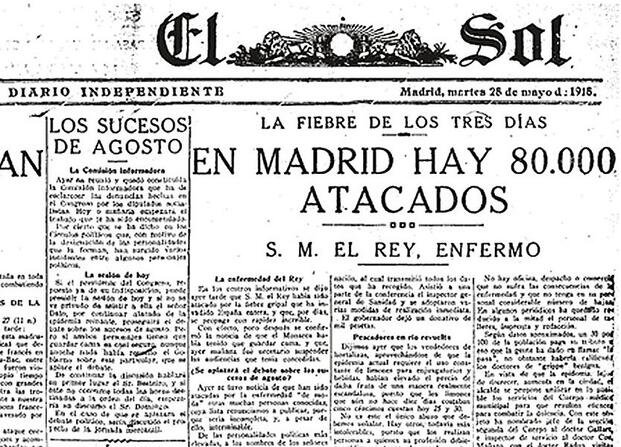
The pandemic's name did not come from any scientific fact, but from wartime censorship. Nations fighting in World War I suppressed press coverage of the outbreak to protect morale. But Spain was neutral. Its newspapers reported freely on the illness sweeping the country, including that King Alfonso XIII had fallen sick.
The uncensored Spanish coverage created a false impression that the outbreak had originated there. The label stuck despite protests from Spanish officials. In an October 1918 letter to the Journal of the American Medical Association, a Spanish health official pushed back.
He wrote that Spanish authorities "were surprised to learn that the disease was making ravages in other countries, and that people there were calling it the 'Spanish grip.'"
The disease did not come from Spain. The strongest evidence, first assembled by historian John M. Barry, traces the outbreak's path from Haskell County, Kansas, to Camp Funston, to Army camps across the country, to the troopships crossing the Atlantic and into the trenches of France.
The Catastrophe
By the time the pandemic finally subsided in 1920, an estimated 500 million people worldwide had been infected. Death estimates range from 50 million to as high as 100 million.
The United States lost roughly 675,000 civilians and service members combined. The military bore an outsized share of that grief. Influenza sickened 26 percent of the Army, more than one million soldiers. Approximately 45,000 U.S. troops died of influenza and related pneumonia, a figure that nearly matches the 53,402 American combat deaths recorded during the entire war. The War Department calculated that the Army lost 8.7 million duty days to the illness in 1918 alone.
Unlike most influenza strains, which prey on the very old and very young, this virus also targeted adults in the prime of life. Men and women aged 20 to 40 died at rates that dwarfed every previous flu season. It was a grim reality for the military. The same age group the Army needed the most was the one the virus killed on a horrific scale.
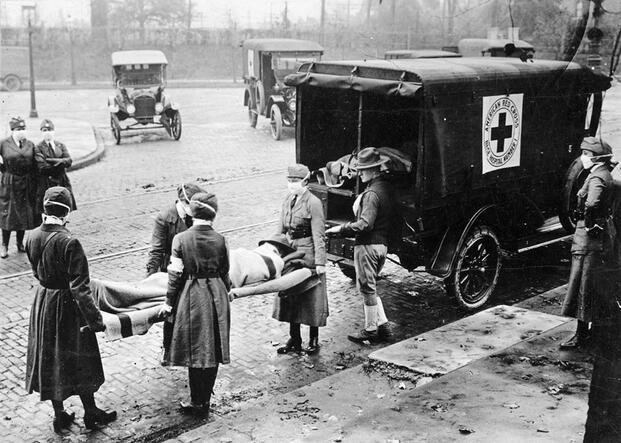
After the Armistice on Nov. 11, 1918, the war ended, but the pandemic continued. A third wave struck over the winter of 1918-1919, as demobilizing troops carried the sickness home to communities across the country.
And then, largely, the country forgot. Author Catharine Arnold noted a reason that resonated deeply with military culture. "Dying from flu was considered unmanly," she wrote. "To die in a firefight, that reflected well on your family. But to die in a hospital bed, turning blue ... there was a mass decision to forget."
The warning that Dr. Loring Miner sent from rural Kansas in early 1918 went unanswered. The troops that had unknowingly contracted the illness in Kansas, soon found themselves at army posts across the nation and in Europe. Only a few years later, up to 100 million people around the world were dead. The horrendous losses were compounded by the fact the illness hit as one of the deadliest conflicts in human history came to a close.





