


How does U.S. Marine Corps' 2026 strategy balance crisis response with modernization for the future?
That’s the theme of the 2026 USMC Aviation Plan (AVPLAN). Published in February, it outlines the strategic vision, key capabilities and future direction for Marine Corps Aviation, aiming to enhance readiness and address emerging threats.
The 2026 AVPLAN has been described by officials as “a significant evolution” from 2025, transitioning from strategic direction to a more concrete, data-driven implementation that introduces more defined, measurable and time-bound initiatives including developing capabilities critical to the Marine Air-Ground Task Force, and leveraging Artificial Intelligence/Machine Learning (AI/ML) to generate an advantage over adversaries.
Like other services, the Marines through the latest AVPLAN is leveraging its strategic goals to translate into warfighting prowess.
“Balancing crisis response is exactly what is going on in the Middle East or anywhere,” Lt. Col Marianne “LOB” Carlson, a Marine Air-Ground Task Force (MAGTF) and planner of aviation vision and strategy with the Cunningham Group, told Military.com. “We are remaining globally responsive to crises around the world, and that is the Marine Corps' bread and butter. We are the global 911 force.”

Carlson, a UH-1Y pilot who has spent the last years in the Marines, was assigned last summer as a head Marine Corps aviation strategist.
“How do we remain postured to respond to any crisis while also modernizing for the future fight? That is a delicate balance, but I think one that the AVPLAN spells out,” she said. “One of the purposes of the AVPLAN is to give a comprehensive look at how we're going to do both—how we are going to respond anywhere around the world, but also look at transforming for the next-generation sites, wherever that may be.”
What is Project Eagle?
One of the core tenets of the AVPLAN is to remain lethal yet modernized. That is being pushed through a framework known as Project Eagle.
According to the plan, Project Eagle guides Marine aviation “toward a future force that is more survivable, more distributed, more data-enabled, and more lethal across the Range Of Military Operations (ROMO).” It has been described as “the connective tissue between strategic guidance and platform-level programs.”
The framework falls under the commandant’s service modernization efforts, establishing the strategic path for Marine Aviation across three Future Years Defense Programs (FYDPs) while enabling the Marine Corps to translate operational requirements into deliberate, long-term modernization.
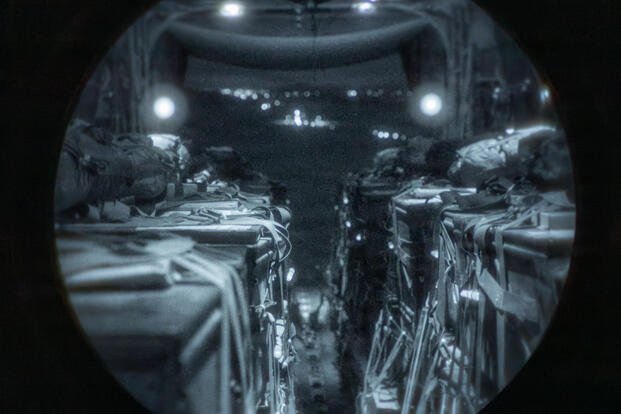
The AVPLAN is aided by five main lines of effort (LOEs): Concepts, Functions, Transformation & Innovation, Resourcing and Roadmaps.
“Project Eagle sets or looks to set conditions for how marine aviation can be resilient, sustainable, persistent and lethal across the range of military operations,” Carlson said. “And then those five LOEs support our ability to do that.
“LOE One is probably, in my mind, the most important because that is the operational North Star for everything that we're trying to do in Marine Corps aviation, specifically our operational concepts, Distributed Aviation Operations and Decision-Centric Aviation Operations.”
Distributed aviation operations, according to Carlson, is Marine aviation's physical posture in austere environments over vast distances. Decision-Centric Aviation Operations, on the other hand, is essentially the cognitive framework for how Marines will achieve decision advantage in those environments.

Functions come into play and are continually evaluated, flourishing through three different lines of operation: dynamic aviation supply, predictive maintenance, and optimized operations.
“Basically, how do we free up the cognitive space for Marines through back-office processes, through logistics, through sustainment, to allow Marines more bandwidth to free up their brain for decisions only humans can make?” she said, adding that artificial intelligence, for example, can turn mundane processes into battlefield advantages.
Resourcing plays into the present and future. Carlson said that translates into long-term plans extending through the year 2040 and beyond, managing budgetary constraints to enable a transition to the next-generation aviation combat element. Roadmaps dictate various plans to achieve that reality.
Planning in an Uncertain World
A lot goes into planning and creating a broad framework such as the AVPLAN, though Carlson acknowledged that past plans used to exceed 300 pages and have become much more digestible over time.
Due to the number of individuals and groups that partake in the process, along with uncertainties at different levels of government and beyond, it can be a tall task. However, the main objectives tend to remain consistent.
“We know the budget changes every year, but just because the budget changes and it ebbs and flows doesn't mean we lose focus on our ultimate goal,” Carlson said. “That's why having a long-term strategy and a vision is important for any organization.

“Our acquisition timelines for platforms are generally longer in aviation. … So, we look out that far to see where we need to go. We look at the future threats, we look at the future operational environment, we look at national joint strategic documents and narratives, and we say, ‘Hey, like based off how the future is changing or expects to change, how do we need to transform ourselves between now and then?’”
Project Eagle is the “rallying flag” pushing that momentum, a “stake in the ground in the future” that creates a unified vision for long-term success.
The 2026 AVPLAN differs from the 2025 plan in multiple ways, too, such as upgrading the F-35 and CH-53K programs within the next five years while focusing more on next-gen platforms—specifically the future attack strike capability, the aerial logistics connectors, some future weaponeer-ing, and unmanned expeditionary platforms or future unmanned aircraft systems (UAS).
Role of AI in Tech, Warfighting
AI plays a giant role in not just the AVPLAN or across the U.S. military, but in everyday tasks worldwide.
Carlson said that the exponential growth of AI technology “is forcing us, encouraging us, enabling us to move very quickly.” Due to the ubiquity of the still emerging technologies, Marines are centering their focus right now on aviation sustainment.
“How do you eat an elephant? One bite at a time,” she said. “Our initial bites are on those very narrow use cases, being aviation supply, aircraft maintenance and operations.”
That translates into better understanding data management, whether in an F-35 or KC-130. That involves data structuring, data access, data ownership, cleansing the data, aggregating the data in a way that's consumable and can be applied to an AI model.
Various AI tools, be it for maintenance, supply, operations or safety, are underneath a singular AI agent known affectionately as Agent Alfred, in honor of Alfred A. Cunningham, the first Marine aviator.
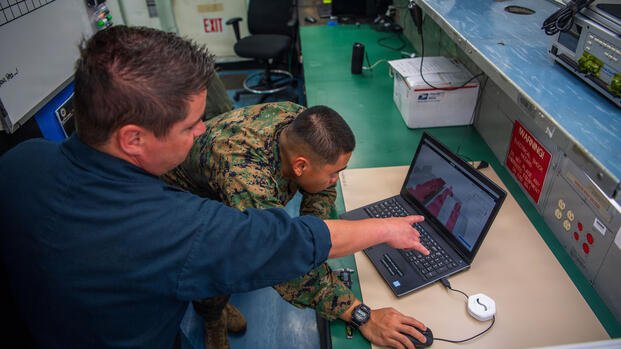
The goal is to get to a place where the Marines have a user interface in their offices, aircraft, on the flight line and in supply warehouses where Marines can interface with Alfred and ultimately free up some bandwidth for decision-making that only humans can make.
But if I can make a Marine more efficient in ordering a part, in fixing an aircraft, in creating a schedule or a training plan, then that's one step closer to achieving decision advantage in a future operational environment or battlefield.
Carlson, however, highlighted the dichotomy between AI and human intelligence. More specifically, wider concerns about computers and robots taking over military operations may be more science fiction at the moment than a reality that many people fear.
“Technology is an enabler, it is and it always will be,” Carlson said. “But at the end of the day, war is a human endeavor. Fighting is a clash of human wills. We'll never, in my personal opinion, have robot wars because you'll always have a human as part of that.”
But technology enables fighters to overcome each other's wills, she added, and likely faster, more efficiently and more effectively—whether that's an AI agent, an advanced platform, advanced weaponry, a computer, a tank, an airplane or GPS.
“Those have all enabled warfighting, but it won't replace the human because to war is to war,” she added. “To fight is a human endeavor.”





