


On the morning of July 10, 1943, Pvt. John P. Rowell and his sentry dog, Chips, hit the beach during Operation Husky. When a hidden machine gun nest opened fire, pinning down the platoon, Chips tore free from Rowell and charged straight into the fortified position. He seized the gunner by the throat, silenced the weapon and forced four Italian soldiers to surrender.
"There was an awful lot of noise," Rowell recalled. "Then I saw one Italian soldier come out the door with Chips at his throat. I called him off before he could kill the man."
That single act of heroism by a mixed-breed family pet from Pleasantville, New York, set Chips on a path to become the most decorated war dog in American history. It also triggered a national debate over whether animals deserve military honors.
From Family Pet to Army Recruit
Chips was born in 1940, a mix of German Shepherd, Collie and Husky-Malamute. He was bred by C.C. Moore, who eventually gave the dog to the family of Edward J. Wren in Pleasantville, New York.
The dog attached himself to Wrens' daughter, Gail. He followed her on the walk to school most mornings and rested beneath her desk in class. If other kids got too physical on the playground, Chips would wedge himself between them and pull Gail to safety.
Chips also had a mischievous streak. He chased chickens around the neighborhood and once bit a garbage collector, behavior that would ironically help him during his military career.
After the Japanese attack on Pearl Harbor in December 1941, the American Kennel Club and a newly formed civilian organization called Dogs for Defense began recruiting privately owned dogs for military service. The group initially intended to provide sentry dogs to the Coast Guard for beach patrols along the American coastline.

On March 13, 1942, Under Secretary of War Robert P. Patterson formally authorized the Quartermaster Corps to begin training dogs, officially creating the War Dog Program that quickly became known as the "K-9 Corps."
The response from American families was overwhelming. More than 19,000 dogs were donated between 1942 and 1945, though roughly 45 percent were rejected as unsuited for training due to poor temperament, sensitivity to gunfire or inadequate sense of smell. Of the roughly 10,425 dogs that completed training, fewer than 1,900 were shipped overseas.
The Wren family recognized Chips’ potential and donated him in August 1942. John Wren, a toddler at the time, later reflected on the sacrifice his parents made.
"It killed my mother to part with him, but Chips was strong and smart, and we knew he'd be good as an Army War Dog," John Wren said in a later interview.
Training and Early Service
Chips shipped out to the War Dog Training Center in Front Royal, Virginia, for training. He trained as a sentry dog for weeks, learning to detect intruders, hold positions and work alongside a handler under simulated combat conditions. His herding and guarding instincts served him well.
He was paired with Pvt. John P. Rowell, a military policeman from Arkansas. The two were assigned to the 3rd Military Police Platoon, 30th Infantry Regiment, 3rd Infantry Division. They deployed together to North Africa in the fall of 1942 as part of Operation Torch, the Allied invasion of French North Africa. Chips was among the first American war dogs to serve overseas.
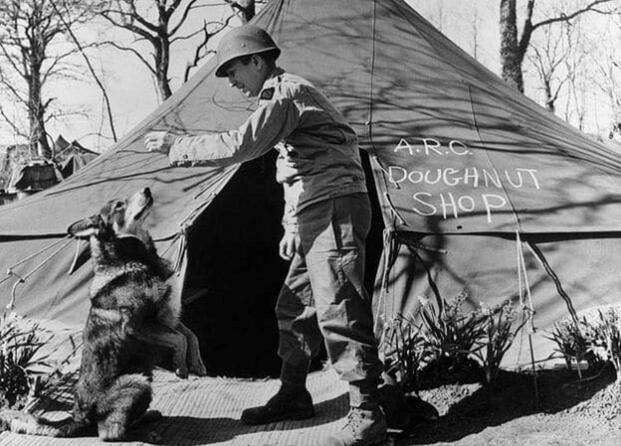
Even before his most famous exploit, Chips demonstrated his value. According to the Military Working Dog Heritage Museum, one of his earliest notable acts in theater was alerting Rowell to a pending ambush. During the ensuing firefight, Chips galloped back to base with a phone cable attached to his collar, dodging small arms fire and allowing the platoon to call for help.
In January 1943, Chips received a unique assignment. He was one of three dogs selected to provide security for President Franklin D. Roosevelt and British Prime Minister Winston Churchill during the Casablanca Conference in French Morocco, where the two leaders plotted Allied strategy for the remainder of the war.
The Machine Gun Nest at Licata
After five months of fighting across North Africa, the 3rd Infantry Division prepared for Operation Husky, the massive Allied invasion of Sicily. Maj. Gen. Lucian K. Truscott led the 3rd Infantry Division ashore near Licata on Sicily's southern coast on July 10, 1943, as part of the largest amphibious operation of the war to that point.
As dawn broke and Rowell's platoon pushed inland, an Italian machine gun nest hidden inside a building opened fire. Several Americans were hit in the opening burst. The rest of the platoon dove for cover with no place to maneuver.
Chips suddenly broke free from Rowell. Despite intense gunfire and Rowell screaming for him to come back, the dog sprinted toward the position. He leapt into the fortification, clamping his jaws around the gunner's throat. In the chaos, the machine gun was knocked over and one of the Italians fired a pistol at Chips, wounding him with powder burns and a scalp laceration.
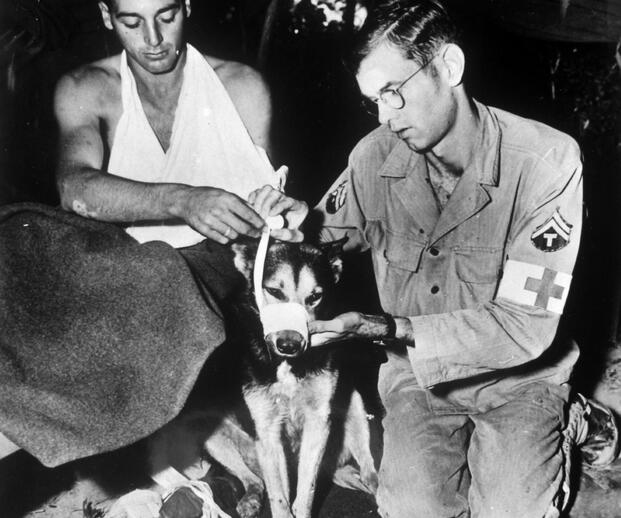
The platoon advanced and captured the four Italian soldiers as medics tended to Chips. His work was not finished. That same night, Chips alerted Rowell to movement beyond their perimeter. The handler and his unit acted quickly, capturing ten more Italian soldiers attempting to slip through their lines under cover of darkness.
The story traveled fast through the division and reached American newspapers not long after. Chips went from an anonymous sentry dog to a household name almost overnight.
Medals, Controversy and Congress
The company’s commander, Capt. Edward G. Parr, recommended Chips for the Distinguished Service Cross, citing his "courageous action in single-handedly eliminating a dangerous machine gun nest and causing surrender of its crew." Chips also received the Silver Star and Purple Heart for his injuries.
War Department regulations technically prohibited awarding decorations to animals. But Truscott felt Chips had earned them. On Nov. 19, 1943, the general personally pinned the Distinguished Service Cross on Chips' collar.
The loudest opposition came from William Thomas, national commander of the Military Order of the Purple Heart. Thomas fired off complaints to the White House, the War Department and the Adjutant General's office, calling it an insult to every soldier who had bled for the same ribbons. The controversy reached Congress, where lawmakers spent three months arguing over the issue
According to a February 1944 report in Time magazine, Maj. Gen. James A. Ulio, the Army's Adjutant General, ultimately decided that Chips would retain his medals, but the military would not award medals to animals again.
Wire service reports from the same period tell a slightly different version, suggesting the DSC was rescinded while the Silver Star and Purple Heart were retained. Regardless of which account is definitive, the U.S. military shut the door on official recognition for war dogs going forward.
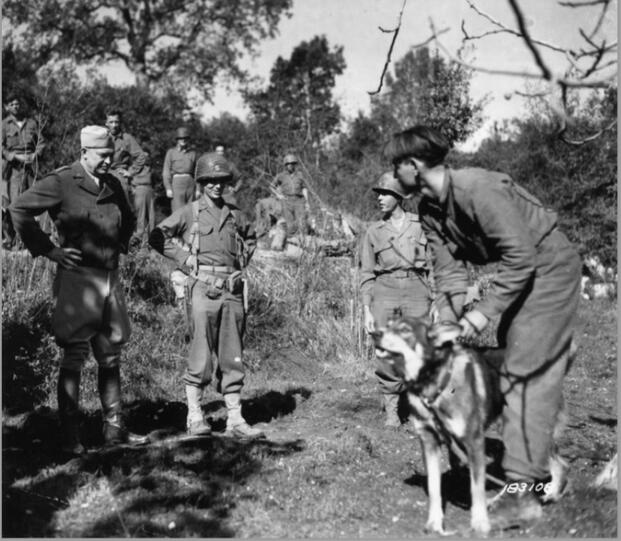
His reputation remained undiminished among the men who served with him. Chips even met Gen. Dwight D. Eisenhower after the Battle of Salerno when the Supreme Allied Commander visited the unit to congratulate them. When Eisenhower leaned down to pet the dog, Chips nipped his hand. As a trained sentry dog, Chips was conditioned to respond aggressively to anyone other than his handler. Eisenhower reportedly took it in stride.
"His response was, 'That's OK. I understand that's what you're trained to do,'" John Wren later recounted.
Eight Campaigns and a Homecoming
Chips continued to serve with Rowell and the 3rd Infantry Division through some of the war's hardest fighting. His campaigns spanned North Africa, Sicily, Salerno, Anzio, the push to Rome, southern France, the Rhineland and Central Europe.
The men of Chips' platoon found their own way to honor him. They unofficially awarded him a Theater Ribbon with an arrowhead, a distinction reserved for airborne and amphibious assault landings, along with eight battle stars representing each campaign in which he served.
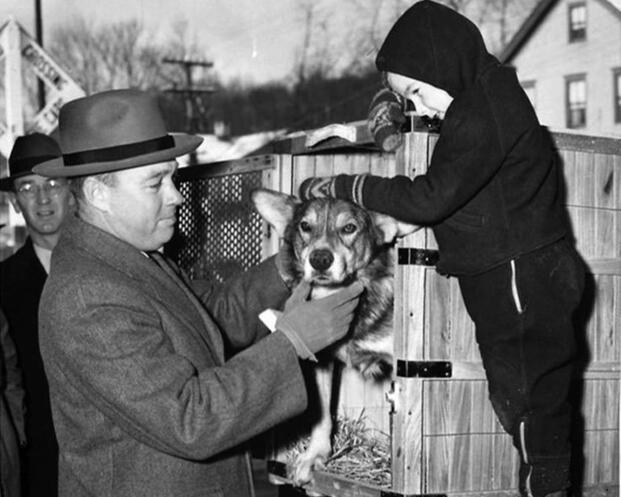
Chips was officially discharged from the Army in December 1945 and returned to the Wren family in Pleasantville. John Wren was four years old when the dog arrived home in a wooden crate, accompanied by photographers and reporters.
"Chips was something of a celebrity when he returned from the war, but we were just pleased to have our dog back," Wren said.
Chips died in 1946, roughly seven months after his discharge. Some sources allege his death was caused by complications related to his combat injuries. He was six years old.
Rowell and the Wren family stayed in touch after the war, exchanging letters for years. Rowell wrote that he was heartbroken when he learned Chips had died.
"He said that Chips and he had slept together an awful lot and that Chips had saved his life many times," Wren said of Rowell's letters.
The Army’s Changing Attitude
The debate over Chips' medals did more than strip honors from a single dog. It helped establish a legal and bureaucratic framework that classified military working dogs as equipment, a status equivalent to a rifle or a tent.
During the Vietnam War, roughly 5,000 dogs served with American forces, credited by military estimates with saving approximately 10,000 lives. When U.S. forces withdrew, the Department of Defense deemed those dogs surplus equipment. Most were handed off to South Vietnamese forces that had neither the training nor the funding to maintain them. Others were put down by American veterinarians before the withdrawal was complete.
Only about 200 made it back to the United States. Handlers who begged to bring their dogs home, even at their own expense, were refused.
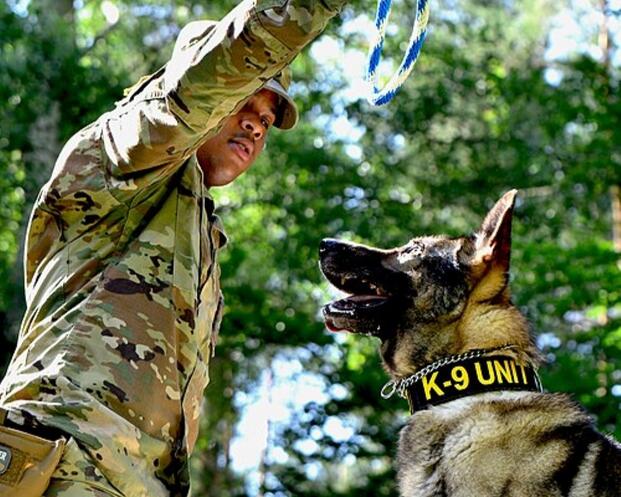
The outcry from Vietnam-era handlers and the public eventually forced widespread change. In 2000, President Bill Clinton signed the "Robby Law," requiring that retired military working dogs be made available for adoption by former handlers, law enforcement agencies or qualified families rather than euthanized.
The 2016 National Defense Authorization Act went further, guaranteeing transportation home for military working dogs serving overseas and giving handlers the first opportunity to adopt them.
Today, the Department of Defense employs more than 1,600 military working dog teams. The dogs are recognized as integral members of their units, a status that took decades of advocacy and tragedy to secure. The direct line between Chips' revoked medals in 1944 and the abandoned dogs of Vietnam in the 1970s remains one of the more painful chapters in American military history.
Recognition, Seven Decades Later
On Jan. 15, 2018, exactly 75 years to the day after the Casablanca Conference, where Chips once stood guard, the People's Dispensary for Sick Animals awarded him the Dickin Medal in a ceremony at the Churchill War Rooms in London. Randolph Churchill, Winston Churchill's great-grandson, even attended the ceremony.
The Dickin Medal is the highest honor any animal can receive for service in military conflict, often described as the animal equivalent of the Victoria Cross. A military working dog named Ayron stood in for Chips at the ceremony while U.S. Army Lt. Col. Alan Throop accepted the medal on behalf of the regiment.
John Wren, then 76 years old, traveled from his home in Southold, New York, to witness the presentation.
"He got a lot of bad press over the years for being a rogue and being dangerous as far as the people were concerned," Wren said. "They didn't like the fact that he'd gotten medals and things like that. So, it really made me feel great to see him finally receive some recognition as a special creature, which, in our view, he was."
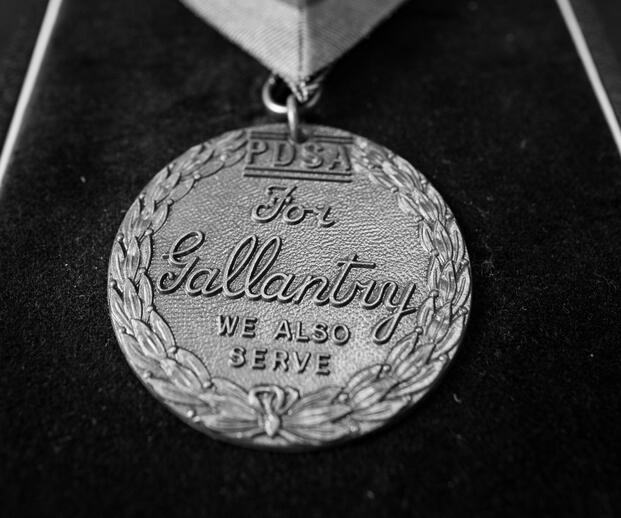
After the ceremony, the Dickin Medal was housed at the National World War II Museum in New Orleans before being transferred in April 2022 to the 3rd Infantry Division Museum at Fort Stewart, Georgia, where it now sits as part of the permanent collection.
In 2019, Chips also received the Animals in War and Peace Medal of Bravery, an American equivalent to the Dickin Medal. That same year, a life-sized bronze statue of Chips, sculpted by Lena Toritch, was unveiled at the Trail of Honor in Lasdon Park in Katonah, New York, roughly 20 minutes from the Pleasantville neighborhood where the Wren family once lived.
In 1990, Disney produced a made-for-TV movie based on his life called "Chips, the War Dog." Smithsonian Magazine named him the most notable wartime canine in American history a decade later.
No American war dog has received more honors for combat service. Military working dogs today are recognized as integral members of their units rather than equipment, a change that traces directly back to the fight over Chips' medals. A family pet from Pleasantville served in eight campaigns, saved his handler's life more than once and single-handedly took out an enemy machine gun nest. He remains the most decorated war dog in U.S. military history, honored alongside names like Audie Murphy and Gen. Joseph T. Dickman as one of the 3rd Infantry Division's own.
Sources: U.S. Army Quartermaster Museum, "Quartermaster War Dog Program"; U.S. Army, "The Dog Hero of the 3rd Infantry Division" (2022); U.S. Army, "War Dogs: The Birth of the K-9 Corps" (2016); PDSA, "Top Honour for WWII Hero Dog" (2018); National Constitution Center, "Honoring the First Dog to Be Awarded the Purple Heart" (2015); CBC Radio, "A Special Creature: Chips the WW II Hero Dog Honoured" (2018); Military Working Dog Heritage Museum, "Chips: A Mixed Breed Dog with Pure Grit"; Vietnam Veterans Memorial Fund, "Dogs of the Vietnam War"; Westchester County Government, War Dog Memorial Dedication (2019); EBSCO Research Starters, "Chips the War Dog"; Vice, "The US Military Euthanized or Abandoned Thousands of Their Own Canine Soldiers at the End of the Vietnam War" (2014); Newsweek, "Hero Dogs of the U.S. K-9 Corps in World War II" (2025); Animals Around the Globe, "Honoring Military Working Dogs Throughout History" (2026).





