


Army Lt. Col. Harold Fritz was mere weeks away from leaving the Vietnam War unscathed and heading home to Lake Geneva, Wisconsin, until he found himself amid a bloody firefight that would change his life and earn him the prestigious Medal of Honor.
Fritz, 81, was born in Chicago but in 1949, his family moved north to Lake Geneva, a Wisconsin tourist magnet. Fritz enjoyed a rather typical Midwestern upbringing, filled with hunting, fishing and Boy Scouts. He played sports and was a member of the Future Farmers of America chapter at Badger High School where he graduated in 1962.
Even at a young age, Fritz was responsible. His principal at Badger praised him as a person “everyone expected to succeed.”
Fritz, pursuing an education degree, attended the University of Tampa. When not in class, Fritz logged time at a factory to support Mary Ellen, his high school sweetheart who became his bride. Mary Ellen had become pregnant with the couple’s first child, Kimberly.
To support his growing family, Fritz dropped a few classes and picked up more factory hours. Uncle Sam noticed. He received a letter stating he was drafted. He chose to enlist and entered the Army in April 1966. He was selected for officer candidate school and after graduating OCS, Fritz was sent to the 11th Armored Cavalry Regiment.

Supreme Act of Bravery
In January 1968, Fritz was assigned to Vietnam. He was promoted to platoon leader for Troop A of the 11th’s 1st Squadron. Having survived nearly a year in a war zone, he was ready to go home. But his leadership would be put to the test in a grueling firefight that seemed insurmountable.
Jan. 11, 1969, began like any other day. Fritz, a first lieutenant at the time, was leading an armored column of seven vehicles along a highway heading south from the Quan Loi Army base in South Vietnam to meet up with a truck convoy. Suddenly, about 270 North Vietnamese soldiers ambushed his troops. Fritz was severely wounded when his vehicle took a direct hit.
Bloody and shaken, but knowing he had to do something, Fritz jumped into his flaming vehicle and started repositioning about 24 of his troops that could still fight, along with the remaining vehicles, hoping it would give his platoon a chance to escape.
“You don’t have time to think about yourself,” Fritz told the Veterans History Project. “You’ve got to remember you have to survive long enough to get your people out of there.”
That’s when adrenaline really kicked in. Fritz ditched his own safety, sprinting from different vehicles, totally out in the open, to keep repositioning his soldiers to strengthen their defenses. Fritz tended to the wounded, handed out ammunition, directed their assault on the NVA, and emboldened the few troops still functioning to keep up the fight.
Fritz led by example, picking up a machine gun and blasting away, inspiring others to return fire, provoking the enemies to abandon the assault.
But they weren’t out of the woods yet.
Minutes after, a second wave of attackers ventured to within 7 feet of his platoon’s position. But Fritz didn’t think about being overwhelmed. He had only a bayonet and a pistol at this point, but it mattered little. Fritz rallied his small, battered group to charge the enemy, invoking significant casualties and pushing them out of position.
“When the odds are the greatest, then you’ve got to be the most daring in what you do to turn them around,” Fritz said. “That’s what happened.”
Finally, relief. Maybe. A backup platoon arrived but Fritz realized it wasn’t deployed adequately. Again, he ran through enemy fire to redirect the platoon’s position, which caused the NVA to nix the ambush completely.
“The North Vietnamese found we were a little tougher [of a] force than they thought,” Fritz told the Veterans History Project.
Lighter Saved Him
Despite being badly wounded, Fritz brushed off medical attention until all his troops were treated and evacuated. Eventually, he was sent to a hospital via helicopter and shrapnel was extracted from his neck and back, and a few gunshot wounds were treated.
What saved his life during this horrendous ordeal? Smoking. Sort of.
Fritz no longer smokes but he did while in Vietnam and a gift from his wife – a Zippo lighter – kept in his breast pocket, prevented a bullet from penetrating his chest.
“If it had not been there, it probably would have hit me in the heart and killed me,” Fritz said. “Not that I'm advocating smoking but had I not been a smoker at that particular point in time, maybe I wouldn’t be here to tell the story.”
He didn’t bring back many items upon leaving Vietnam in March 1969, but he made sure that Zippo was packed.
Medal of Honor ‘Overwhelming’
He remained in the Army and was assigned to Fort Lewis, Washington. In early 1971, he was getting ready to relocate to Fort Benning, Georgia when he fielded a surprise call.
“Congratulations, Capt. Fritz,” the caller said. “You’ve just been awarded the Medal of Honor.”
“At first, it was disbelief,” Fritz said. “It takes a while for it to really sink in.”
Fritz was invited to the White House where President Richard Nixon pinned the Medal of Honor – the nation’s highest award for valor – around his neck on March 2, 1971, joining five fellow Army troops and one Marine to receive the honor.
“It was really overwhelming,” Fritz said. “I feel very humble and proud to be a recipient.”
Fritz and Mary Ellen had two more children, sons Christopher and Jeffrey, and he stayed in the Army while finishing up his degree from the University of Tampa in 1975. In 1993, after almost 28 years in the Army, Fritz retired as a lieutenant colonel.
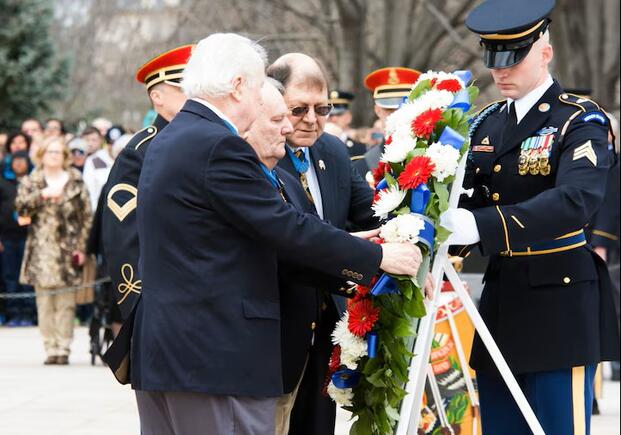
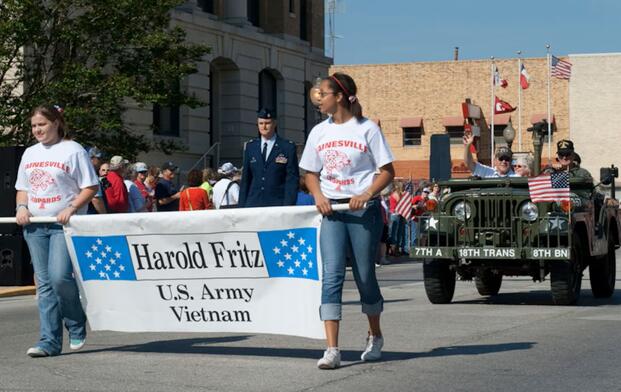
For the past three decades, Fritz has participated in several events tied to veterans and speaks to students about the Medal of Honor and its significance.
“I try to tell people the important job that the military plays in keeping this country safe,” he said.
And the accolades didn’t end after his military retirement. About 10 years ago, he served as president of the Congressional Medal of Honor Society. In 2024, the Veterans Assistance Commission in Peoria, Illinois was named in his honor and the airfield at Fort Irwin, California was named Fritz Field.





