


As parts of the U.S. begin to thaw out from a frigid and stormy winter season, Alaska is still very much in the winter doldrums. But over the years, Alaska Army National Guard troops have largely adapted to the challenges of a frigid climate -- except when it comes to emergency travel and rescue.
“We need to accept that medical evacuation may be delayed or denied altogether in a high-end Arctic fight,” said Major Titus Rund, 207th Aviation Troop Command flight surgeon, in a statement obtained by Military.com. “If we can’t stabilize and protect our injured in the cold, we lose more than lives. We lose initiative.”

It’s a message that was relayed to Army National Guard Lt. Gen. Jon Stubbs, during a recent visit to Joint Base Elmendorf-Richardson (JEBR) in Anchorage. Just a few weeks ago, on February 20, Stubbs was at JEBR on a listening tour, hearing from troops operating at what he called “the tip of the spear.”
“The things that you deal with in terms of the conditions, the tyranny of distance and the challenges that come with operating in this type of environment, whether it is just training, Warrior Battle Tasks and Drills, collective training at echelon, it’s not simple,” said Stubbs in remarks released to Military.com. “It speaks to the character of this great organization.”
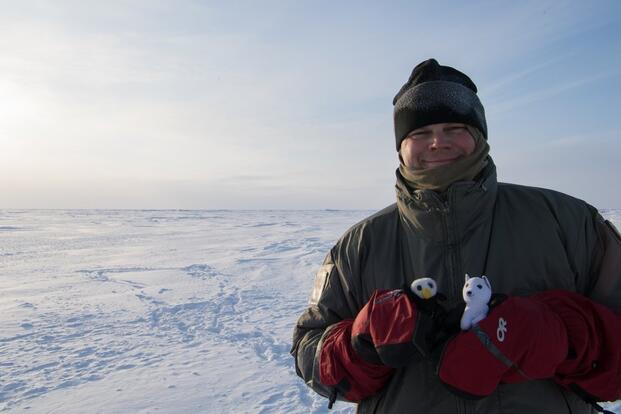
During Stubbs’ visit, the mercury in Anchorage was down to six degrees below zero. That level of cold along with the state’s extended nighttime darkness and the vast and largely undeveloped terrain can make working and living in Alaska like an obstacle course. Only a fraction of the state is connected by highway, leaving aviation as the only way to reach most communities, even for injured soldiers.
“My goal is that Soldiers get the best care possible and back to their families on the worst day of their lives,” Rund said. “When time is tissue, the urgency to effectively treat patients in the extreme cold is crucial.”
In Alaska, the U.S. military relies on the so-called “Golden Hour,” an agreed upon window of time depending on daylight, temperature and climate conditions as the standard for evacuating critically wounded and injured troops to high level medical care.
Major Rund says it’s time for change in Arctic or extreme-cold environments. He has submitted a patent on behalf of the Department of War for a casualty-evacuation, or CASEVAC, ecosystem. It creates a “bubble of warmth” for victims and care providers in a casualty protection unit – a combined shelter and sled. The design allows for a safe and rapid evacuation no matter the outside conditions.
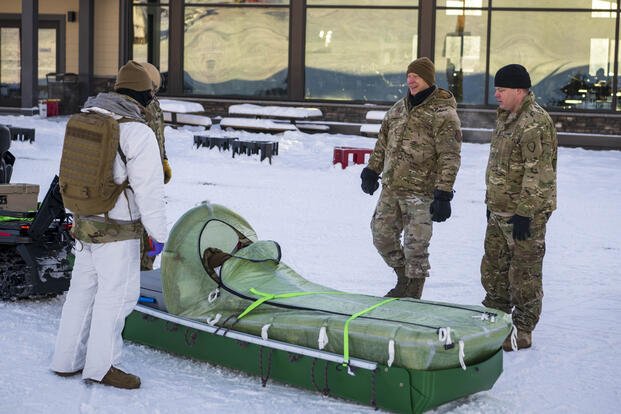
Rund’s patent is pending, but it’s the type of equipment that could have been used during hurricane-force storms last fall that devastated Western Alaska communities. According to the Alaska National Guard, the 207th Aviation Troop Command’s response involved a helicopter unit flying more than 330 hours, evacuating 501 civilians, transporting 741 disaster response personnel and carrying more than 90 tons of cargo.
“What you were doing, no kidding, saved lives,” General Stubbs said. “You were in the midst of hoisting people off structures that were swept out to sea, saving lives and preserving families. It was incredible.”
The staggering distance traveled only added to the challenge. One end of the state to the other, between Attu in the Aleutian Islands to Belle Bay in Southeast Alaska, spans 2,400 miles, almost as far as New York City to Los Angeles.
“Nobody does what the National Guard does,” Stubbs said. “Nobody can do what we do – Citizen Soldiers out there at the tip of the spear inside your respective states.”
National Guard Soldiers, Stubbs said, must be ready to respond to disasters and unrest both in their states and when called abroad in overseas deployments.
“Being a Soldier in the Army National Guard is a big deal,” Stubbs said in his remarks. “We are proud of you, we are proud of who you are, what you do and what you represent.”





